
The Sam Houston Tollway (Beltway 8) is the primary outer commercial ring serving Greater Houston. Circling industrial parks, intermodal shipping yards, chemical plants, and port connectors, Beltway 8 sees intense commercial freight transport 24 hours a day. Flatbeds, chemical tankers, and dry vans haul steel coils, construction equipment, petrochemical drums, and consumer goods.
When cargo is improperly secured or an 18-wheeler is loaded beyond its legal weight limits, the truck turns into a highway hazard. Overloaded trucks have longer stopping distances and are prone to tire blowouts, rollover crashes, and spilled cargo that can shut down all lanes of Beltway 8.
At Grimes & Fertitta, P.C., our truck accident trial attorneys in Houston Texas hold motor carriers, freight loaders, and commercial shippers accountable for unsafe, overloaded, and unsecured freight. We investigate loading tickets and corporate weight logs to build strong injury claims.
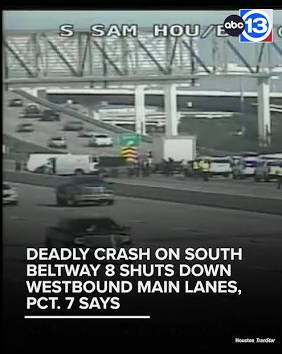
Cargo spills and rollovers on Beltway 8 shut down traffic lanes. Source: Facebook
1. The Physics and Hazards of Overloaded Commercial Trucks
Federal and Texas state laws restrict the weight of commercial motor vehicles to protect roadway integrity and ensure vehicle control:
- Gross Vehicle Weight Rating (GVWR): Maximum gross weight of 80,000 pounds on interstate highways without special oversized permits.
- Single Axle Limit: Maximum of 20,000 pounds.
- Tandem Axle Limit: Maximum of 34,000 pounds.
How Overloading Causes Catastrophic Crashes:
- Brake System Failure: Excessive weight generates thermal brake fade. Brakes overheat and fail on highway exit ramps.
- Tire Blowouts: Overloading puts extreme pressure on tire sidewalls, causing blowouts at highway speeds.
- Increased Stopping Distances: An overloaded semi-truck traveling at 65 mph on Beltway 8 requires significantly more stopping distance than an empty vehicle.
- High Center of Gravity Rollovers: Top-heavy trailers tilt and roll over when navigating elevated interchange ramps.
2. Unsecured Cargo and FMCSA Cargo Securement Rules (49 CFR Part 393)
Under FMCSA regulations, all cargo carried by commercial vehicles must be firmly secured to prevent shifting, falling, leaking, or blowing off the vehicle:
Aggregate tie-downs must equal at least 50% of cargo weight
Must withstand 0.8g deceleration forward and 0.5g lateral
Strict rules for steel coils, concrete pipes, and machinery
When a flatbed carrier hauling oilfield drill pipes or steel beams on Beltway 8 uses defective chains or fails to use edge protectors, shifting cargo can snap tie-downs. The resulting cargo spill can strike trailing passenger cars or crush adjacent vehicles.
3. Identifying the Responsible Corporate Parties
Proving who caused an overloaded or shifted cargo crash requires looking beyond the driver:
| Liable Party | Basis of Legal Claim in Texas |
|---|---|
| The Cargo Shipper | Negligently loading freight; falsifying weight bills; failing to disclose true freight weight. |
| Third-Party Logistics / Stevedores | Inadequately blocking and bracing cargo inside sea containers or trailers. |
| The Motor Carrier | Permitting trucks to depart terminals without certified scale weight tickets; failing to train drivers on load securement. |
| The Truck Driver | Failing to inspect cargo securement within the first 50 miles of a trip, as required by 49 CFR § 392.9. |
4. Critical Evidence in Houston Cargo Accident Cases
To establish liability against industrial shippers and trucking companies, our legal team gathers:
- Bills of Lading and Freight Invoices: Revealing actual cargo weights and delivery deadlines.
- Certified Weigh Scale Tickets: Showing axle weights before the truck entered public highways.
- Physical Chain and Strap Inspections: Analyzing whether tie-downs met FMCSA Working Load Limit (WLL) ratings or showed pre-existing fraying.
- TxDOT Commercial Vehicle Enforcement Inspection Reports: State Trooper weight citations and safety violation records issued at the scene.
Frequently Asked Questions (FAQs) – Article 10
1. Who is liable if cargo falls off a truck and hits my vehicle on Beltway 8?
Liability may fall on the trucking company, the truck driver, and the third-party company that loaded and secured the cargo.
2. What if I hit spilled cargo that was already lying in the road?
Under Texas law, the company that spilled the cargo is liable for creating a dangerous roadway hazard. If the spill was recent, their liability remains primary.
3. What is a “Working Load Limit” (WLL) for cargo straps?
The WLL is the maximum load a tie-down strap or chain can safely support. Federal rules mandate that total tie-down capacity must equal at least half the weight of the cargo being secured.
4. How do weigh stations on Texas highways detect overloaded trucks?
TxDOT operates fixed weigh stations and uses mobile Weight-In-Motion (WIM) sensors along freeways to identify vehicles exceeding axle limits.
5. Can a trucking company avoid liability by blaming an independent loading company?
Under 49 CFR § 392.9, the truck driver and carrier have an independent legal duty to inspect and confirm cargo securement before driving, regardless of who loaded the freight.
6. What injuries are common in cargo spill crashes?
These crashes frequently cause traumatic crush injuries, severe fractures, internal organ lacerations, and burn trauma from hazardous chemical spills.
7. Can I recover damages if an overloaded truck hit me during bad weather?
Yes. Motor carriers are required by 49 CFR § 392.14 to use extreme caution and reduce speed during hazardous weather conditions like heavy rain.
8. What is the statute of limitations for an overloaded truck crash in Houston?
Under Texas Civil Practice and Remedies Code § 16.003, you have two years from the date of the crash to file a lawsuit.
Authoritative Sources
FMCSA 49 CFR Part 393 (Parts and Accessories for Safe Operation),
Texas Transportation Code Chapter 621 (Vehicle Size and Weight).