
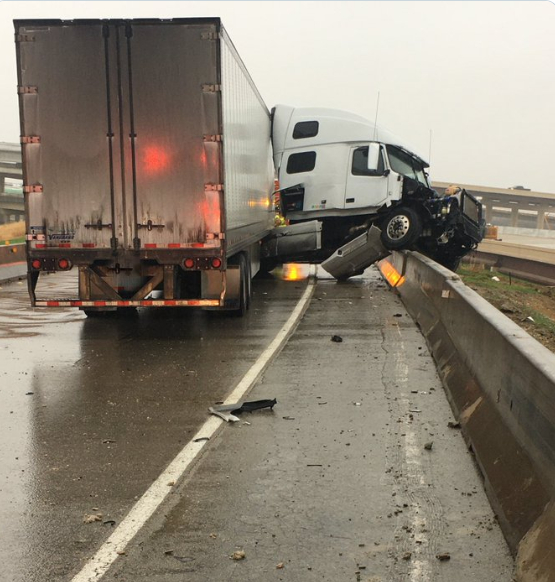
Among all commercial motor vehicle collisions, few cause more catastrophic injuries than underride and jackknife accidents. On high-speed Houston corridors such as the North Freeway (I-45), East Freeway (I-10), and Sam Houston Tollway (Beltway 8), these wrecks often result in passenger vehicle decapitation, severe crush trauma, or fatal multi-car pileups.
When an 18-wheeler jackknifes across multiple lanes or a smaller vehicle slides beneath a commercial trailer, the legal battle centers on corporate maintenance failures, driver error, and equipment defects.
At Grimes & Fertitta, P.C., our commercial vehicle trial lawyers in Houston, Texas represent victims and families navigating catastrophic truck accident claims. We analyze physical crash evidence to trace liability back to the motor carrier, trailer manufacturer, and maintenance contractors.
1. Understanding Underride Accidents: Mechanics and Regulatory Failures
An underride crash occurs when a passenger vehicle strikes a commercial semi-trailer and slides directly beneath it. Because the bed of a trailer sits roughly 45 inches off the pavement, the initial point of impact bypasses the passenger car’s crumple zones and front bumper. The trailer bed slices directly into the vehicle’s windshield and passenger cabin, causing catastrophic head and spinal injuries.
Types of Underride Collisions:
- Rear Underride: A passenger car strikes the rear of a slowing or stopped truck on a freeway or feeder road.
- Side Underride: A semi-truck makes an improper U-turn, pulls across traffic, or executes an unsafe lane change, causing a car to slide underneath the side of
Rear Impact Guards (49 CFR § 393.86)
Federal safety standards require commercial trailers manufactured after 1998 to be equipped with Rear Impact Guards (often called “Mansfield bars”). Despite federal rules, many trailers operate with corroded, weak, or improperly attached guards that shear off upon impact. Side underride guards are not yet federally mandated on all trailers, making side-impact collisions along Houston’s unlit highway stretches particularly deadly.
2. The Physics of Jackknife Accidents on Houston, TX Highways
A jackknife collision occurs when a semi-truck’s drive wheels lock up, causing the trailer to swing outward at an acute angle relative to the tractor, sweeping across adjacent travel lanes like a giant blade.
Primary Causes of Jackknife Crashes in Houston:
- Sudden, Panic Braking: Inexperienced drivers slamming on air brakes during sudden slowdowns near the Loop 610/I-69 Westpark interchange.
- Improper Brake Balance: Faulty trailer air brake valves causing the trailer wheels to lock while tractor wheels continue rolling.
- Hydroplaning on Wet Roads: Heavy Gulf Coast downpours cause standing water on highway lanes, causing empty or light trailers to lose traction.
- Excessive Speed for Conditions: Entering highway transition ramps or curves too quickly.
3. Establishing Corporate Liability: Who Is Legally Responsible?
Commercial trucking companies frequently attempt to classify underride and jackknife crashes as “unavoidable road accidents.” Our investigation targets all negligent entities:
| Responsible Entity | Basis of Legal Claim |
| The Motor Carrier | Failure to inspect rear impact guards; encouraging drivers to operate in severe weather; negligent driver training. |
| The Truck Driver | Speeding on wet roads; aggressive lane changes; blocking travel lanes during illegal turns. |
| Trailer Manufacturers | Defective rear underride guard design; using brittle steel alloys that fail standard crash tests. |
| Maintenance Contractors | Failing to repair rusted guard weld joints; improper adjustment of tractor-trailer air brake timing. |
| Cargo Shippers / Loaders | Uneven cargo distribution, making the trailer tail-heavy and prone to lateral sliding during braking. |
4. Forensic Investigation Protocols in Catastrophic Truck Collisions
Proving corporate liability in an underride or jackknife crash requires technical accident reconstruction:
- Metallurgical Analysis: Examining fractures in sheared rear impact guards to determine whether metal fatigue, rust, or substandard welding contributed to the structural failure.
- Brake Timing Tests: Testing the tractor-trailer’s pneumatic air brake system to verify whether uneven brake lag caused the trailer to swing outward.
- Electronic Stability Control (ESC) Downloads: Reviewing ECM data to evaluate whether the vehicle’s automated rollover and stability systems engaged.
- Lighting and Visibility Audits: Evaluating whether the trailer’s retroreflective sheeting (DOT-C2 conspicuity tape) complied with 49 CFR § 393.13.
Frequently Asked Questions (FAQs) – Article 9
1. What is a side underride collision?
A side underride accident occurs when a passenger car slides beneath the side of a commercial trailer, often while the truck is turning across lanes, backing up, or executing an improper lane merge.
2. Are trucking companies required to have underride guards on trailers?
Federal law requires rear impact guards on trailers manufactured after January 26, 1998 (49 CFR § 393.86). Side underride guards are currently voluntary under federal law, but failure to install available safety equipment can be used to establish common-law negligence.
3. Can an empty trailer cause a jackknife crash more easily than a loaded one?
Yes. An empty or lightly loaded trailer has significantly less downforce and tire traction on wet pavement, making it far more prone to wheel lockup and lateral swinging during sudden braking.
4. What types of injuries are common in underride accidents?
Underride collisions frequently cause severe traumatic brain injuries (TBIs), decapitation, facial fractures, and upper spinal cord severance due to direct cabin intrusion.
5. How does Texas comparative fault apply if I hit the back of a truck?
Under Texas’s 51% modified comparative fault rule (CPRC § 33.001), if the truck had disabled or missing lights, a defective underride guard, or was illegally stopped in a travel lane, you can recover compensation as long as your share of fault is 50% or less.
6. Can trailer manufacturers be sued for underride guard failures?
Yes. If the rear impact guard fractured due to defective design or weak materials, you can file a strict product liability lawsuit against the trailer manufacturer.
7. What damages can surviving families recover in a fatal underride crash?
Under the Texas Wrongful Death Act (CPRC § 71.002), surviving spouses, children, and parents can recover lost financial support, loss of companionship, mental anguish, and funeral costs.
8. How quickly should an accident reconstruction team examine the crash scene?
Immediately. Roadway yaw marks, fluid trails, and trailer scrape marks on the pavement can disappear within days due to rain and heavy traffic.
Authoritative Sources: